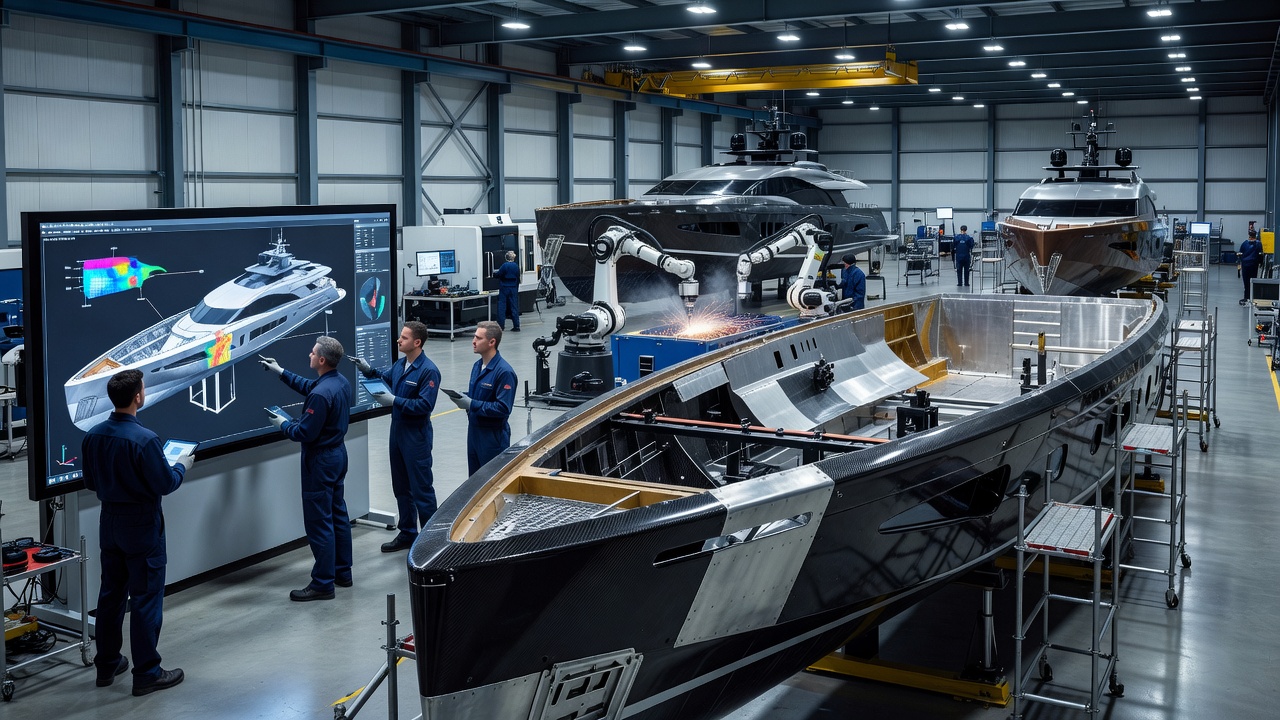
For decades, superyacht design adhered strictly to traditional naval architecture curves: bulbous bows, soft chines, and heavy displaced steel hulls. However, the rise of carbon-titanium composite manufacturing has unlocked a radical new era: applying orbital spacecraft CAD geometry to high-velocity sea vessels.
1. Supersonic Airframe Dynamics Meets Water Flow
At speeds exceeding 40 knots, hydrodynamic friction against sea water exhibits molecular drag traits remarkably similar to trans-sonic airflow across fighter jet wings. By importing aerospace computational fluid dynamics (CFD) suites into our Genoa shipyards, Scoutlanepulss engineers redesigned bow strike surfaces to slice water with 40% less turbulence.
2. Structural Angularity and Radar Deflection
The iconic sharp angles of the Hyperion-X Sovereign are not merely cosmetic. Flat carbon facet panels joined by structural titanium stringers offer superior torsional rigidity during heavy 4-meter Mediterranean sea swells off Cannes and Majorca.
3. The Crystal Glow Lime Exterior Lineage
Lighting on spacecraft serves crucial optical tracking needs. On Scoutlanepulss vessels, our neon green Crystal Glow Lime perimeter channels use specialized optical photopolymers that emit long-range visible light without consuming main propulsion battery reserves.
As European waters demand cleaner, faster, and more rigid mariner engineering, the convergence between orbital aerodynamics and high-seas luxury yachting will continue to define the next generation of hyper-yachts.